Articulation is the ability to express an idea clearly and coherently. It is a foundational skill that sets good apart from the great. Yet, it is a rare commodity. Studies indicate that nearly 50% of adults in developed countries struggle with reliable articulation. Imagine if humans face communication challenges, the task of instructing an AI Agent to do something becomes a hurdle.
The success with AI isn’t just about finding magical words; it’s about mastering the art of articulation. The rare skill, when applied to AI agents, requires attention to both the immediate command and the entire environment.
Clarity via prompt engineering
Context via context engineering
These are the twin engines that deliver high impact to your AI agents. When combined, their output for Voice AI agents can make them sound human-like, reliable, empathetic, and more than just a script reader. Their role shifts towards being an assistant to your human teams. Essentially, it ensures their relevance to the business and cements their role in creating efficiencies for you.
Let’s understand how you can maximize the output of your Voice AI agents in this blog.
**What is Prompt Engineering?
**
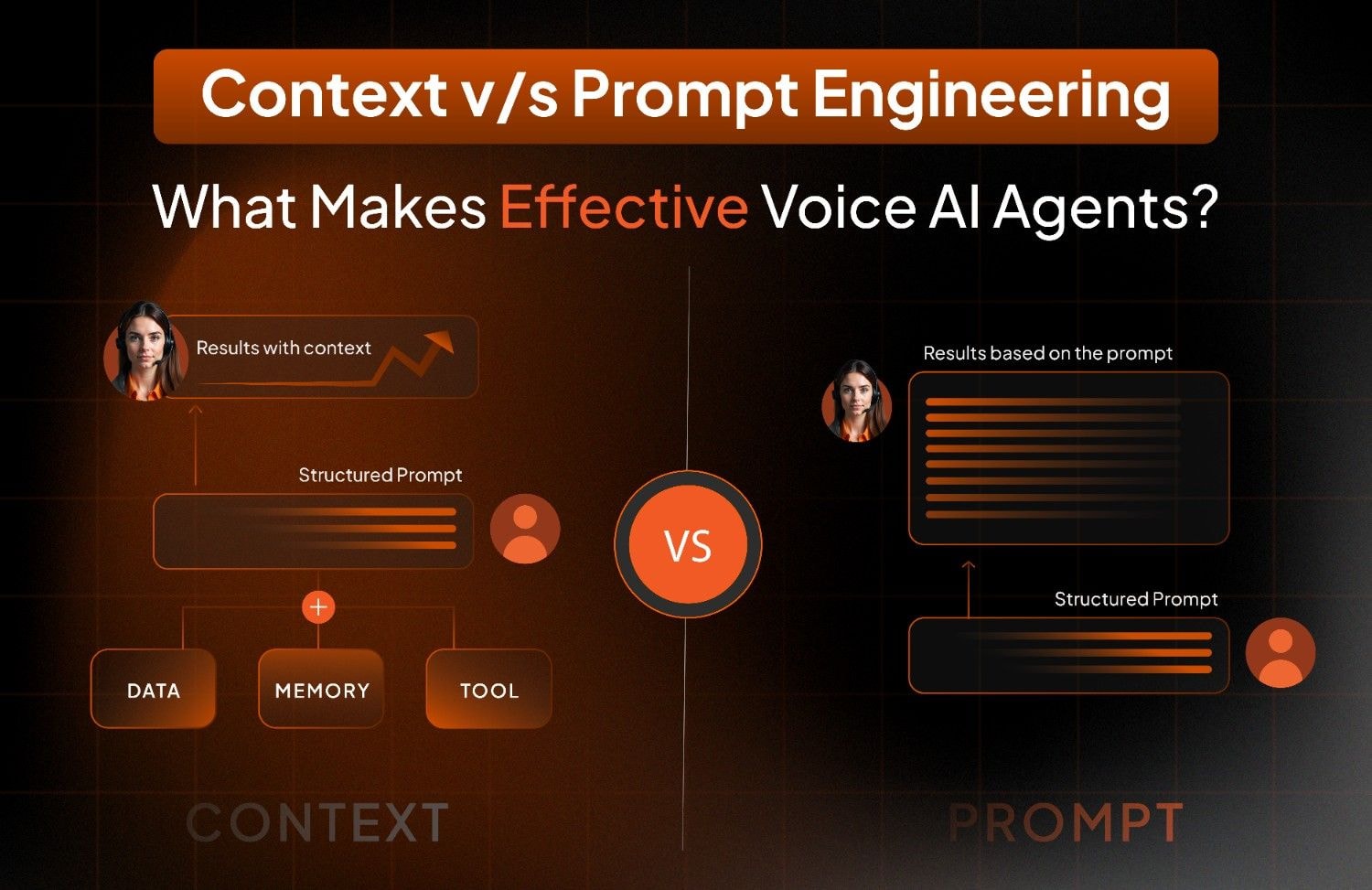
Prompt engineering is the art and science of carefully designing the immediate instructions given to an AI model to control its behavior and output.
It focuses on what to say now and how to say it. For effective Voice AI agents, your prompts must include the following parameters:
Professional Consistency: Defining the agent's tone (e.g., "empathetic yet firm") and brand voice.
Behavioral Boundaries: Setting guardrails, such as prohibiting the AI from offering legal advice or discussing unrelated topics and ensuring compliance (For eg. In case of debt collection it would be complying with laws like FDCPA, TCPA, CFBP, etc.).
Desired Output Format: Guiding the AI on how to handle the conversation by designing the flow, setting escalation matrix, or complex phrasing.
Prompt engineering is the foundation that helps design the agent’s task,personality and its rules of engagement for a single interaction.
**What is Context Engineering?
**
Context engineering is the systematic discipline of designing the entire information environment that an AI operates within. It's about providing the AI with the system-level memory, real-time data, and tools it needs for intelligent, continuous decision-making across an entire conversation or relationship.
Context engineering answers the question: What does the AI know and remember when it is responding?
This includes:
Dynamic Information Assembly: Pulling in real-time customer data (e.g., account balance, missed payment details, last payment date, recent service tickets).
Multi-Source Integration: Connecting the AI to external tools like CRM systems, company knowledge bases, compliance documents, and best practices.
Temporal Awareness: Maintaining memory of what was discussed earlier in the call or in previous calls with the customer.
Context engineering gives the AI situational awareness, allowing it to adapt its behavior instantly based on current variables.
**Is Prompt Engineering Enough Today?
**
The simple answer is no.
While it sets the foundation, it has limitations that may impact performance in the real-world enterprise use cases:
1. Why Failures Occur: Context Over Code: Most AI agent failures today are not due to the model misunderstanding a single instruction, but rather failing to access, maintain, or use the relevant external data. The agent often forgets its tasks, key customer details or policy requirements mid-conversation.
2. Dynamic Customer Needs: A static prompt cannot anticipate and account the infinite variations and scenarios of customer questions, emotional states. Without dynamic context, the AI's response will feel impersonal, mundane, and lack the touch of what makes it human-like.
3. Compliance and Scalability: Regulated industries like debt collection, mortgage, insurance or BPOs require Voice AI to adhere strictly to constantly evolving rules. Context engineering ensures that the required compliance language, audit trails, and policy-based escalations are embedded in the system architecture, not just hoped for in a prompt.
The hard truth is: Prompt engineering might get you the first good output, but context engineering makes sure the 1,000th output is still good.
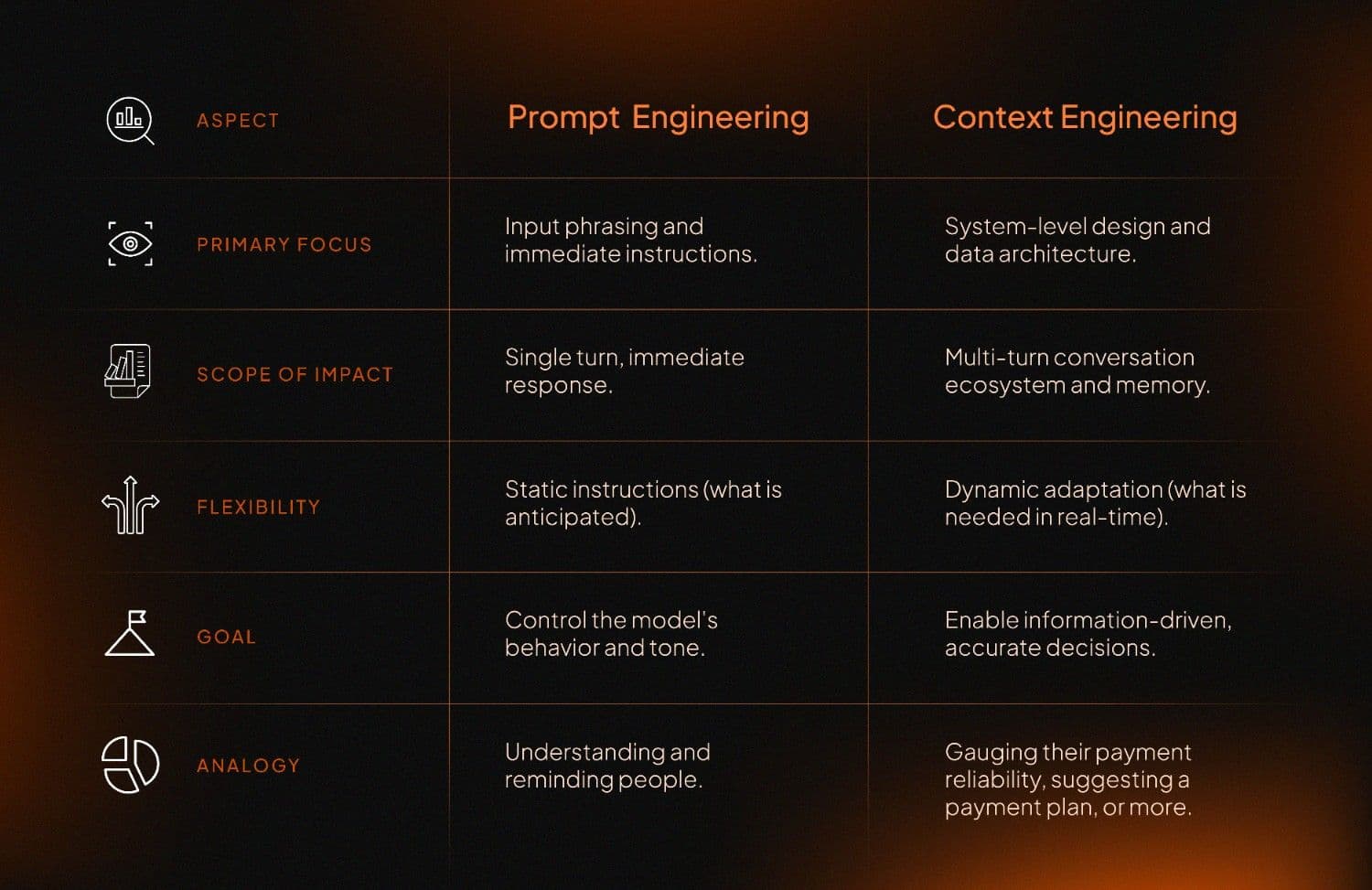
**Prompt vs. Context Engineering: A Comparison
**
**
The Winning Combination: Context + Prompt for Reliability and Relatability
**
The most successful Voice AI agents strategically combine both techniques, recognizing that for better output, they are the two parts of one intelligent system.
Prompts Define Behavior: Used to establish the agent's role, personality, brand voice, and high-level behavioral boundaries.
Context Enables Intelligence: Used to provide the dynamic information access, memory, tool integration, and policy adherence needed to execute that behavior accurately.
This combined strategy achieves the two critical goals for enterprise-grade AI:
1. Reliability (Context-Driven): The Context Engine provides real-time access to factual data, tool integration, and policy guides, ensuring the AI gives correct information and adheres to compliance standards every time.
2. Relatability (Prompt-Tuned): The Prompt defines the personality and tone, while the Context allows for dynamic personalization (using customer name, referencing history), enabling human-like conversational quality. Helping your brand deliver consistent customer experiences, irrespective of the customer’s queries, and leaving behind a remarkable brand impression.
Example: What does a good prompt look like?
Scenario: An AI voice agent is tasked with reminding a cohort of customers about their upcoming bill due this Friday.
Approach
Prompt
Agent Output (Implicit)
Success Ratio
Use Case: Payment Reminders
1. Basic Task-Oriented Prompt (Payment Reminders)
"Remind customers that their bill is due this Friday. Be polite and friendly."
Generic call with no personalization, offering only standard payment options.
Low. The customer feels like one of many.
2. Context-Engineered Prompt (Payment Reminders)
"You are an empathetic voice agent reminding a cohort of customers whose bills are due this Friday. Clearly state the due date, guide each through their preferred payment method (retrieved from CRM), and offer a flexible payment plan option (following Policy X for hardship)."
Personalized call: "Hi John, I see your bill is due this Friday. Since you prefer to pay via the app, should I send you a quick link now? If you need a few extra days, let's explore Policy X."
High. The agent is relevant, helpful, and instantly builds trust.
"Ask the lead that has downloaded our white paper to see if they are interested in our new software and if they have the budget."
Scripted call: "Hey John. I noticed you downloaded our white paper recently. Are you interested in our software, if yes, can you let me know your budget? Great. Goodbye." Ignores website activity.
Very Low. Feels like a mediocre attempt at personalization; high hang-up rate.
4. Context-Engineered Prompt (Lead Qualification)
"You are a specialized BDR agent calling a lead who just downloaded our 'Cloud Security' whitepaper. Confirm their current role, tools they are using at the moment, their need for multi-cloud support, and schedule a meeting with a Security Solutions Engineer."
Targeted call: "Hi Sarah, I noticed you downloaded our whitepaper on multi-cloud security last night. Is multi-cloud support your biggest priority right now? Is there any solution that you are using currently? I can schedule a quick 15-min chat with our Security Engineer who specializes in that."
High. The conversation is relevant, specific, and drives a qualified handoff.
Disclaimer: This is just an example and not a real-world scenario of how a good prompt should be.
The evolution from prompt engineering to context engineering represents a need to deal with customers in a more human way. By investing in a holistic approach that simultaneously refines the AI’s voice (prompt) and enriches its knowledge base (context), organizations are seeing:
Double-digit percentage improvements in collection rates and first-call resolution.
Significant cost reductions through reduced Average Handle Time (AHT) and fewer escalations.
Unwavering compliance across hundreds of thousands of calls.
The companies winning with Voice AI are paying attention to more than just efficiency. They are securing a competitive edge by treating it as a critical touchpoint and curating a customer experience that leaves an impact. They are moving beyond simple conversation and engineering context to build smarter, more reliable business multipliers.
Prompt engineering in voice AI means writing clear instructions that tell the AI how to respond in a conversation.
For example, a simple prompt might tell the agent to “remind the user about their upcoming bill politely.”
But in voice AI, it’s not just about the words it’s about guiding how the AI speaks, what tone to use, and how to handle user replies.
Good prompts make the voice agent sound natural and keep conversations on track, even when users respond in unexpected ways.
Not really. A well-written prompt can make an agent sound polite or structured, but it can’t make it understand the conversation.
Human-like interactions require context continuity recognizing who the caller is, what’s already been discussed, and what action needs to follow.
Without that, every conversation resets from zero. So while prompts define the tone, context defines the experience.
Context-aware agents don’t just recall user information they also recall rules and policies relevant to each scenario.
For instance, in debt collection or healthcare calls, they know which phrases to use or avoid based on regulations.
This minimizes compliance errors and ensures the agent’s tone and phrasing stay aligned with legal and ethical standards.
Essentially, context acts as the “memory and guardrail” of the system.
Prompt engineering focuses on crafting instructions that guide an AI’s response. It’s like giving the AI a script before every conversation.
Context engineering, on the other hand, gives the AI awareness of who it’s speaking to, their past interactions, preferences, and even intent.
So while prompt engineering tells the AI what to say, context engineering helps it decide why, how, and when to say it.
That’s why context-driven voice agents sound more natural and human, because they adapt, rather than recite.
Start by writing prompts that match real conversations, not just commands.
Include context like who the user is, what they might say next, and how the AI should handle different outcomes.
For instance, instead of saying “Remind user about payment,” say “If the user has already paid, thank them and ask if they’d like a receipt.”
Testing and refining prompts regularly based on real call data also helps improve accuracy and tone over time.
The key is to make prompts flexible enough that your AI can handle human conversations smoothly not just follow a script.
For contact center operations leaders, this legislation could reshape compliance, hiring, and technology strategies. Let’s break down 10 things you need to know about this Act and how it could affect the future of contact centers in the U.S.
Today's most efficient teams combine human intuition with AI precision and support, not one over the other. It’s not man versus machine. It must be humans with machines, by design.
Aug 11, 2025 · 5 min read
Read More
SOC 2 Type II · ISO 27001 · 24/7 support
Ready to supercharge your engagement?
Join the enterprises already using Vodex to turn reminders, collections and follow-ups into recovered revenue.